




Stefan Zweig (geboren am 28. November 1881 in Wien, Österreich-Ungarn; gestorben am 23. Februar 1942 in Petrópolis, Brasilien) war ein österreichischer Schriftsteller, Übersetzer und Pazifist. Zweig gehörte zu den beliebtesten deutschsprachigen Schriftstellern seiner Zeit. Mit seinen vielgelesenen psychologischen Novellen wie Brennendes Geheimnis (1911), Angst, Brief einer Unbekannten, Der Amokläufer und literarisierten Biographien, darunter Magellan. Der Mann und seine Tat sowie Triumph und Tragik des Erasmus von Rotterdam, gehörte er zu den bedeutenden deutschsprachigen Erzählern zu Beginn des 20. Jahrhunderts. Seine Sprache ist durch Anschaulichkeit und klangliche Gefälligkeit gekennzeichnet; die Werke sind in ihrer Erzählweise sowie den stilistischen Mitteln weitgehend dem Realismus verpflichtet. Sie vereinigen klassische Elemente, darunter einen dramatischen Handlungsablauf, mit psychoanalytisch gezeichneten Figuren und betrachtet aus unterschiedlichen Perspektiven. So bot Zweig seiner breiten Leserschaft einen Zugang zu einer Literatur, in der ihre Gegenwart reflektiert wurde, ohne sie mit modernistischen Erzählweisen zu konfrontieren. Unter seinen zahlreichen Prosaarbeiten ragen besonders die Schachnovelle, die Sternstunden der Menschheit sowie seine Erinnerungen Die Welt von Gestern hervor.
Stefan Zweig (born November 28, 1881, in Vienna, Austria-Hungary; died February 23, 1942, in Petrópolis, Brazil) was an Austrian writer, translator, and pacifist. Zweig was among the most popular German-language writers of his time. With his widely read psychological novellas such as Burning Secret (1911), Fear, Letter from an Unknown Woman, and The Amok, as well as literary biographies including Magellan: The Man and His Deed and Triumph and Tragedy of Erasmus of Rotterdam, he was one of the most important German-language storytellers of the early 20th century. His language is characterized by vividness and sonorous quality; his works, in their narrative style and stylistic devices, are largely committed to realism. They combine classical elements, including a dramatic plot, with psychoanalytically drawn characters and are viewed from diverse perspectives. Zweig thus offered his broad readership access to a literature that reflected their present without confronting them with modernist narrative styles. Among his numerous prose works, the novella The Royal Game, The Tide of Fortune, and his memoir The World of Yesterday stand out in particular.
Source: Stefan Zweig, Wikipedia.
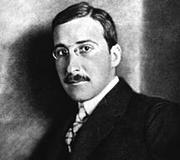


1809 works Add another?
 Most Editions
Most Editions
First Published
Most Recent
Top Rated
Reading Log
Trending
Random

![Cover of: Briefwechsel, 1912-1942.: [Von] Stefan Zweig [und] Friderike Zweig.](/images/icons/avatar_book-sm.png "Cover of: Briefwechsel, 1912-1942.: [Von] Stefan Zweig [und] Friderike Zweig.")

Subjects
Biography, History, Fiction, Austrian Authors, Correspondence, Austria, fiction, Fiction, general, Fiction, short stories (single author), Translations into English, Fiction, psychological, Description and travel, Drama, German Authors, Zweig, stefan, 1881-1942, Criticism and interpretation, History and criticism, Mental healing, Authors, biography, Queens, German Short stories, German literature, Germanic literature, French Authors, Jews, Marie antoinette, queen, consort of louis xvi, king of france, 1755-1793Places
France, Austria, Great Britain, America, Brazil, Europe, Scotland, Germany, Spain, Cologny, Portugal, Switzerland, Belgium, Brasilien, England, Grande-Bretagne, Italy, Lyon (France), O sterreich-Ungarn, Paris, Prague (Czech Republic), Russia (Federation), Vienna (Austria), ao di li, e guoPeople
Stefan Zweig (1881-1942), Honoré de Balzac (1799-1850), Charles Dickens (1812-1870), Leo Tolstoy graf (1828-1910), Fyodor Dostoyevsky (1821-1881), Mary Queen of Scots (1542-1587), Giacomo Casanova (1725-1798), Stendhal (1783-1842), Friedrich Wilhelm Nietzsche (1844-1900), Jean Calvin (1509-1564), Marie Antoinette Queen, consort of Louis XVI, King of France (1755-1793), Martin Luther (1483-1546), Romain Rolland (1866-1944), Heinrich von Kleist (1777-1811), Sébastien Castellion (1515-1563), Friedrich Hölderlin (1770-1843), Sigmund Freud (1856-1939), Jeremiah (Biblical prophet), Joseph Fouché duc d'Otrante (1759-1820), Desiderius Erasmus (d. 1536), Franz Anton Mesmer (1734-1815), Mary Baker Eddy (1821-1910), Emile Verhaeren (1855-1916), Marceline Desbordes-Valmore (1786-1859), Michael Servetus (1511?-1553)Time
20th century, 19th century, Elizabeth, 1558-1603, Mary Stuart, 1542-1567, 1789-1815, Louis XVI, 1774-1793, 1871-1918, 18th century, 1918-1945, zhong shi ji, 11881-1942, 1542-1567 (Marie Stuart), 1558-1603, 1558-1603 (Élisabeth Ire), 1789-1793, 1870-1914, 1900-1945, 1933-1945, French Revolution, Revolution, 1789-1799, Siglo XX, jin dai, xian daiID Numbers
- OLID: OL26439A
- Amazon ID: B001HCYZQ0
- BookBrainz: 7b831345-4ef3-4156-8bb7-9091ca197073
- GoodReads: 25573
- ISNI: 000000012099475X
- IMDb: nm0959003
- Inventaire: wd:Q78491
- Library of Congress Names: n79138567
- LibraryThing: zweigstefan
- LibriVox: 10209
- MusicBrainz: 554180e0-5e8c-431b-a541-46447aa99d45
- Project Gutenberg: 26291
- SBN/ICCU (National Library Service of Italy): CFIV000386
- VIAF: 19685936
- Wikidata: Q78491
Links outside Open Library
No links yet. Add one?
Alternative names
- Стефан Цвейг
- Stephen Branch
| November 9, 2025 | Edited by Miguel | Edited without comment. |
| November 9, 2025 | Edited by Miguel | Edited without comment. |
| August 10, 2025 | Edited by Erraticonteuse | Edited without comment. |
| August 10, 2025 | Edited by Erraticonteuse | Edited without comment. |
| April 1, 2008 | Created by an anonymous user | initial import |