

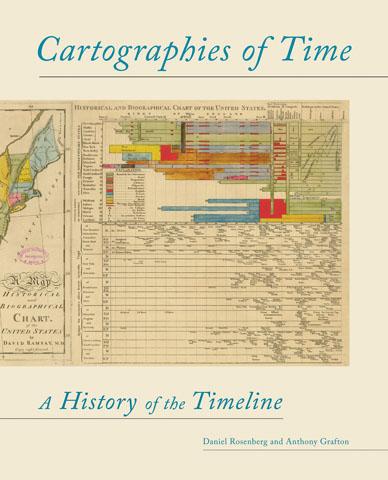
The first comprehensive history of graphic representations of time in Europe and the United States from 1450 to the present. Lavishly illustrated.
Previews available in: English
Subjects
People
Places
| Edition | Availability |
|---|---|
1

Cartographies of time
2009, Princeton Architectural Press
Hardcover
in English
- First edition
1568987633 9781568987637
|
aaaa
|
Book Details
Table of Contents
Edition Notes
Includes bibliographical references. 268 color illustrations; 40 b/w illustrations.
Classifications
The Physical Object
Edition Identifiers
Work Identifiers
Source records
- Library of Congress MARC record
- Library of Congress MARC record
- marc_openlibraries_sanfranciscopubliclibrary MARC record
- amazon.com record
- Library of Congress MARC record
- Better World Books record
- marc_columbia MARC record
- Harvard University record
- marc_nuls MARC record
- Internet Archive item record
- Harvard University record
Work Description
What does history look like? How do you draw time?
From the most ancient images to the contemporary, the line has served as the central figure in the representation of time. The linear metaphor is ubiquitous in everyday visual representations of time—in almanacs, calendars, charts, and graphs of all sorts. Even our everyday speech is filled with talk of time having a "before" and an "after" or being "long" and "short." The timeline is such a familiar part of our mental furniture that it is sometimes hard to remember that we invented it in the first place. And yet, in its modern form, the timeline is not even 250 years old. The story of what came before has never been fully told, until now. More at Princeton Press...
Links outside Open Library
Community Reviews (0)
Lists
