




The Prince
by Niccolò Machiavelli
- 1,553 Want to read
- 127 Currently reading
- 171 Have read







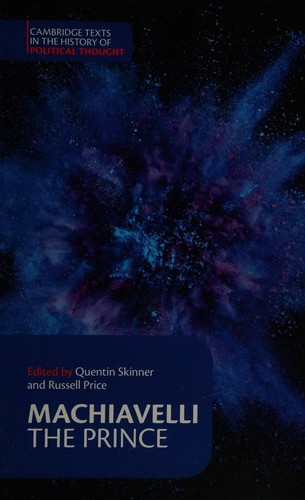


In his introduction to this new translation by Russell Price, Professor Skinner presents a lucid analysis of Machiavelli's text as a response both to the world of Florentine politics, and as an attack on the advice-books for princes published by a number of his contemporaries. This new edition includes notes on the principal events in Machiavelli's life, and on the vocabulary of The Prince, as well as biographical notes on characters in the text.
Check nearby libraries
Buy this book

Previews available in: English Spanish Japanese
Subjects
People
Places
Times
Showing 14 featured editions. View all 1407 editions?
| Edition | Availability |
|---|---|
01

|
bbbb
|
02

|
zzzz
|
03

The Prince
2013-12-12, CreateSpace Independent Publishing Platform
in English
1494461943 9781494461942
|
cccc
|
04

|
cccc
|
05

|
bbbb
|
06

|
cccc
|
07

|
cccc
|
08

|
aaaa
|
09

|
cccc
|
10

|
zzzz
|
11

|
cccc
|
12

|
cccc
|
13

|
bbbb
|
14

|
bbbb
|
Book Details
Edition Notes
Bibliography: p. xxix-xxxi.
Translation from the Italian of: Il principe.
Includes indexes.
Classifications
The Physical Object
Edition Identifiers
Work Identifiers
Source records
Work Description
The Prince (Italian: Il Principe [il ˈprintʃipe]; Latin: De Principatibus) is a 16th-century political treatise written by Italian diplomat and political theorist Niccolò Machiavelli as an instruction guide for new princes and royals. The general theme of The Prince is of accepting that the aims of princes – such as glory and survival – can justify the use of immoral means to achieve those ends.
From Machiavelli's correspondence, a version appears to have been distributed in 1513, using a Latin title, De Principatibus (Of Principalities). However, the printed version was not published until 1532, five years after Machiavelli's death. This was carried out with the permission of the Medici pope Clement VII, but "long before then, in fact since the first appearance of The Prince in manuscript, controversy had swirled about his writings".
Although The Prince was written as if it were a traditional work in the mirrors for princes style, it was generally agreed as being especially innovative. This is partly because it was written in the vernacular Italian rather than Latin, a practice that had become increasingly popular since the publication of Dante's Divine Comedy and other works of Renaissance literature.
Links outside Open Library
Community Reviews (0)
Lists