
















Open any book on the science of light and vision, and you cannot miss the name of Thomas Young.
An edition of The Last Man Who Knew Everything
(2005)
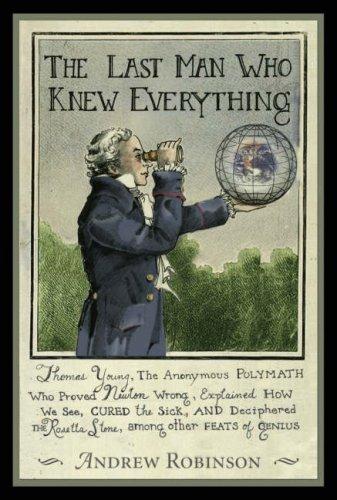
The last man who knew everything
Thomas Young, the anonymous polymath who proved Newton wrong, explained how we see, cured the sick, and deciphered the Rosetta stone, among other feats of genius
by Andrew Robinson
- 138 Want to read
- 11 Currently reading
- 10 Have read

Share
×Close
Relates the life of the remarkable man who made major contributions in such fields as physics, languages, and music, describing how he proposed the light-wave theory and the three-color theory of vision, and was instrumental in the deciphering of the Rosetta Stone.
Check nearby libraries
Buy this book

Previews available in: English
Subjects
Physicians, Linguists, Science, Scientists, Discoveries in science, Biography, History, Young, thomas, 1773-1829, Scientists, biography, Physicians, biography, Science, history, Physicians, great britain, BG, BGT, BJ, HDDG, BIO000000, BIO015000, HIS002030, decipher, Egyptologist, physician, physicist, Rosetta Stone, Thomas YoungPeople
Thomas Young (1773-1829)Places
Great BritainTimes
19th century, 18th centuryBook Details
Edition Notes
Includes bibliographical references and index.
Classifications
External Links
The Physical Object
Edition Identifiers
Work Identifiers
Source records
Work Description
No one has given the polymath Thomas Young (1773–1829) the all-round examination he so richly deserves—until now. Celebrated biographer Andrew Robinson portrays a man who solved mystery after mystery in the face of ridicule and rejection, and never sought fame.
As a physicist, Young challenged the theories of Isaac Newton and proved that light is a wave. As a physician, he showed how the eye focuses and proposed the three-colour theory of vision, only confirmed a century and a half later. As an Egyptologist, he made crucial contributions to deciphering the Rosetta Stone. It is hard to grasp how much Young knew.
This biography is the fascinating story of a driven yet modest hero who cared less about what others thought of him than for the joys of an unbridled pursuit of knowledge—with a new foreword by Martin Rees and a new postscript discussing polymathy in the two centuries since the time of Young. It returns this neglected genius to his proper position in the pantheon of great scientific thinkers.
Excerpts
added anonymously.
Lists
Wikipedia citation
×CloseCopy and paste this code into your Wikipedia page. Need help?