




How buildings learn
what happens after they're built
by Stewart Brand
- 199 Want to read
- 4 Currently reading
- 9 Have read






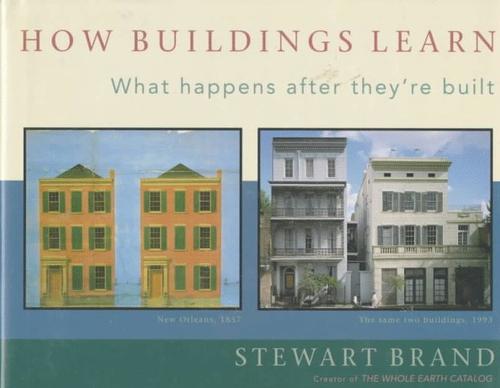


"Buildings have often been studied whole in space, but never before have they been studied whole in time." "Architects (and architectural historians) are interested only in a building's original intentions. Most are dismayed by what happens later, when a building develops its own life, responsive to the life within. To get the rest of the story - to explore the years between the dazzle of a new building and its eventual corpse - Stewart Brand went to facilities managers and real estate professionals, to preservationists and building historians, to photo archives and to futurists. He inquired, "What makes some buildings come to be loved?" He found that all buildings are forced to adapt, but only some adapt gracefully." "How Buildings Learn is a masterful new synthesis which proposes that buildings adapt best when constantly refined and reshaped by their occupants, and that architects can mature from being artists of space to becoming artists of time. A rich resource and point of departure, as stimulating for the general reader and home improvement hobbyist as for the building professional, the book is sure to generate ideas, provoke debate, and shake up habitual thinking." "From the connected farmhouses of New England to I.M. Pei's Media Lab, from "satisficing" to "form follows funding," from the evolution of bungalows to the invention of Santa Fe Style, from Low Road military surplus buildings to a High Road English classic like Chatsworth - this is a far-ranging survey of unexplored essential territory." "More than any other human artifact, buildings improve with time - if they're allowed. How Buildings Learn shows how to work with time rather than against it."--Jacket.
Check nearby libraries
Buy this book

Previews available in: English
Subjects
| Edition | Availability |
|---|---|
1

How buildings learn: what happens after they're built
1997, Phoenix Illustrated, Weidenfeld Nicolson Illustrate, Orion Publishing Group, Limited
in English
- Rev. ed.
0753800500 9780753800508
|
zzzz
|
2

How buildings learn: what happens after they're built
1995, Penguin Books
in English
0140139966 9780140139969
|
eeee
|
3

How Buildings Learn: What Happens After They're Built
October 1995, Tandem Library
Hardcover
in English
0613920090 9780613920094
|
zzzz
|
4

How Buildings Learn: What Happens After They're Built
October 1, 1995, Penguin (Non-Classics)
Paperback
in English
0140139966 9780140139969
|
zzzz
|
5

How Buildings Learn: What Happens After They're Built
October 1, 1995, Penguin (Non-Classics)
in English
0140139966 9780140139969
|
zzzz
|
6

How buildings learn: what happens after they're built
1994, Viking
in English
0670835153 9780670835157
|
aaaa
|
Book Details
Edition Notes
Includes bibliographical references (p. 224-229) and index.
Classifications
The Physical Object
Edition Identifiers
Work Identifiers
Source records
Work Description
Buildings have often been studies whole in space, but never before have they been studied whole in time. How Buildings Learn is a masterful new synthesis that proposes that buildings adapt best when constantly refined and reshaped by their occupants, and that architects can mature from being artists of space to becoming artists of time. From the connected farmhouses of New England to I.M. Pei's Media Lab, from "satisficing" to "form follows funding," from the evolution of bungalows to the invention of Santa Fe Style, from Low Road military surplus buildings to a High Road English classic like Chatsworth -- this is a far-ranging survey of unexplored essential territory. More than any other human artifacts, buildings improve with time -- if they're allowed to. How Buildings Learn shows how to work with time rather than against it. - Publisher.
Community Reviews (0)
Lists