

An edition of The Rise and Decline of Nations
(1982)
The rise and decline of nations
economic growth, stagflation, and social rigidities
by Mancur Olson
- 31 Want to read
- 1 Currently reading
- 1 Have read
Share
×Close





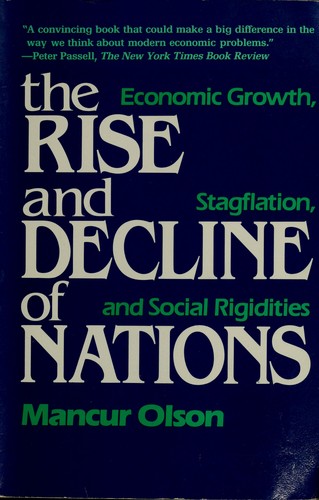
A leading political economist advances a new theory to explain the postwar shifts in the relative economic fortunes and positions of various nations and regions.
Check nearby libraries
Buy this book

Previews available in: English
Subjects
People
Places
Times
| Edition | Availability |
|---|---|
1

Rise and Decline of Nations: Economic Growth, Stagflation, and Social Rigidities
2008, Yale University Press
in English
0300157673 9780300157673
|
zzzz
|
2

The Rise and Decline of Nations: Economic Growth, Stagflation, and Social Rigidities
September 10, 1984, Yale University Press
Paperback
in English
0300030797 9780300030792
|
zzzz
|
3

The rise and decline of nations: economic growth, stagflation, and social rigidities
1982, Yale University Press
Hardcover
in English
0300023073 9780300023077
|
aaaa
|
Book Details
Table of Contents
Preface
Edition Notes
Includes bibliographical references and index.
Classifications
The Physical Object
Edition Identifiers
Work Identifiers
Source records
- Scriblio MARC record
- Ithaca College Library MARC record
- Library of Congress MARC record
- Internet Archive item record
- Internet Archive item record
- marc_openlibraries_phillipsacademy MARC record
- Better World Books record
- Library of Congress MARC record
- marc_columbia MARC record
- Harvard University record
- Harvard University record
Work Description
Explores the relation between economic development and collective action, hypothesizing that small collectives are dynamic and flexible enough to quickly react to changes, encouraging economic development, while large collectives are slow and inflexible when faced with change, leading to economic decline.
Community Reviews (0)
Lists