

1 - 20 of 35 results
-

Hell
VI. The probability of the sun's being the local hell, with reasons for this conjecture; and the objections from atheism, philosophy, and the Holy Scriptures, answered.V. The improbability of that fire's being in, or about the center of the earth.IV. That the fire of hell is not metaphorical, but real.III. The several opinions concerning the place of hell.First published in 1727
2 editions, 2 ebooks -

62. According to 2 Timothy 3:16, all Scripture is given by inspiration of God. How then are we to understand the many Old Testament passages that can hardly be harmonized with Christian teaching?. Page 184 11. What kind of kingdom is Jesus speaking about in Matthew 25:31-46? Is it identical with the "kingdom of God"? Is it possible to enter the eternal kingdom on the basis of good deeds?. Page 31 34. Why did the rich man, in the Parable of the Rich Man and Lazarus, go to hell? (Luke 16:19-31). Page 100 35. How are we to understand Jesus' saying about the two swords? Does it not contradict his teaching on non-resistance? (Luke 22:38). Page 103 First published in 2001
1 edition, 1 ebook -

1 edition -

Hell
1 edition -

v. 1. Everything Jesus taught about Himself, God, the Holy Spirit, the Scriptures.v. 5. Everything Jesus taught about angels, Heaven, Satan, Hell, the Kingdom, the Second Coming.v. 4. Everything Jesus taught about love, marriage and divorce, women and children.v. 2. Everything Jesus taught about man, sin, repentance, forgiveness, salvation, righteousness.v. 3. Everything Jesus taught about faith, humility, money, prayer, the Sabbath, sickness, and death.First published in 1976
3 editions, 2 ebooks -

2 editions -

Curing a cold -- Aurelia's unfortunate young man -- Information for the million -- The killing of Julius Caesar "localized" -- Lucretia Smith's soldier -- A touching story of George Washington's boyhood -- Advice to little girls -- "After" Jenkins -- Answers to correspondents -- Mr. Bloke's item -- A page from a Californian almanac -- The scriptural panoramist -- Among the spirits -- Brief biographical sketch of George Washington -- A complaint about correspondents -- Concerning chambermaids -- Honored as a curiosity -- An inquiry about insurances -- Literature in the dry diggings -- Origin of illustrious men -- The facts concerning the recent resignation -- General Washington's Negro body-servant -- Information wanted -- My late senatorial secretaryship -- An ancient playbill - Back from "Yurrup" -- The Benton House -- A fine old man -- Guying the guides -- Mental photographs -- Rev. Henry Ward Beecher's farm -- The Turkish bath -- The case of George Fisher -- An entertaining articleConcerning the American language -- Legend of Sagenfeld in Germany -- On the decay of the art of lying -- Paris notes -- The art of inhumation -- Keelboat talk and manners -- Introduction to "The new guide of the conversation in Portuguese and English" -- A petition to the Queen of England -- A majestic literary fossil -- About all kinds of ships -- A cure for the blues -- The enemy conquered; or, Love triumphant -- Traveling with a reformer -- Private history of the "Jumping frog" story -- Fenimore Cooper's literary offenses -- A hell of a hotel at Maryborough -- The Indian crow -- At the appetite cure -- The Austrian Edison keeping school again -- From the "London Times" of 1904 -- My first lie and how I got out of it -- My boybood dreams -- Amended obituraries -- Does the race of man love a lord? -- Instructions in art -- Italian with grammer -- Italian without a master -- The petrified man -- The Dutch Nick massacreA couple of poems by Twain and Moore -- An encounter with an interviewer -- Johnny Green -- The jumping frog -- The office bore -- "Party cries" in Ireland -- Petition concerning copyright -- The Siamese twins -- Speech at the Scottish banquet in London -- Speech on accident insurance -- The facts concerning the recent carnival of crime in Connecticut -- Letter read at a dinner -- Punch, brothers, punch -- Some rambling notes of an idle excursion -- Speech on the weather -- The Whittier birthday speech -- About magnanimous-incident literature -- O'Shah -- The great revolution in Pitcairn -- Speech on the babies -- American in Europe -- An American party -- Ascending the Riffelberg -- The awful German language -- The great French duel -- The king's encore -- The laborious ant -- My long crawl in the dark -- Nicodemus Dodge -- Skeleton for the Black Forest novel -- A telephonic conversation -- Two works of art -- Why Germans wear spectacles -- Young Cholley Adams -- Plymouth Rock and the PilgrimsHistory repeats itself -- John Chinaman in New York -- The judge's "spirited woman" -- The late Benjamin Franklin -- Map of Paris -- My bloody massacre -- A mysterious visit -- Note on "The petrified man" -- Post-mortem poetry -- Riley - newspaper correspondent -- Running for governor -- To raise poultry -- The undertaker's chat -- The widow's protest -- Wit inspirations of the "two-year-olds" -- About barbers -- A burlesque biography -- The danger of lying in bed -- A fashion item -- First interview with Artemus Ward -- My first literary venture -- A new Beecher church -- Portrait of King William III -- "Blanketing" the Admiral -- A deception -- A genuine Mexican plug -- The great landslide case -- How the author was sold in Newark -- A hundred and ten tin whistles -- Lionizing murderers -- Markiss, king of liars -- Mr. Arkansas -- Nevada nabobs -- What Hank said to Horace Greeley -- When the buffalo climbed a tree -- A curious pleasure excursion -- Rogers -- After-dinner speechFirst published in 1961
5 editions, 3 ebooks -
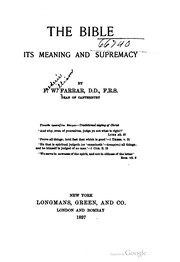
The Bible exhibits immense variety with essential unity. References of our Lord and the Apostles to the Old Testament. Corrected estimates of the Law in the New Testament. 1. Preciousness of the variety of Scripture. 'Amicta varietatibus.' Everything for some, something for all. Insight into many minds. Characteristics of their diversity. 'As universal as our race, as individual as ourselves.' 'Homo sum' Further illustrations. Influence of the Bible on human history. 2. Unity of the Scriptures, especially in the Revelation of Christ. 'In Vetere Testamente Novum latet; in Novo Vetus patet' The true value and message of Scripture to be derived from its final teaching in the Gospels ; and its true unity is in Christ 47The formula of the Church is 'Scriptura continet verbum Dei.' Cartwright's seven arguments that 'the Bible is the word of God.' They are only tenable when applied to the essential revelation of Scripture. Luther never adopted the erroneous formula. The Scriptures as a whole never claim to be 'the word of God' The phrase never once applied to the Bible as a whole, either in the Old or the New Testament. The expressions of Scripture itself. The teaching of the Universal Church on this subject has always been in accord with that of Scripture itself. John of Damascus. Doctrine of the Anglican Church. The difference between vague, rhetorical, general phrases and exact definition. The rigid identification of all Scripture with the word of God hardly earlier than 1550, and it led to monstrous excesses. 'Complectitur' not 'est' throughout our formula. Christ alone is 'the Word of God 142The Bible not one homogeneous book, but a collection of writings gradually admitted into a varying canon. All Christians alike believe in the supremacy of Scripture ; but every word of it is not superaaturally dictated— Nor infallible. That view has been prolific of disaster. The Bible is a library. Why called 'sacred' and 'holy.' Gradual growth of the conception of 'the Bible' as one book. The word 'Bible.' Gradual formation of the Canon. Philo; Josephus; New Testament writers ; the Talmud, Old Testament, Apocrypha. Uncanonical books once accepted as sacred in the Christian Church. The Homologoumena and Antilegomena. The final test of canonicity was the reason and conscience of Christians. Boldness and independence of Luther. The Old Testament Canon. Ezra. The Scribes; the Rabbis; Rabbi Aqiba. Difficulties about Ecclesiastes, Ezekiel, the Song of Songs. The Law, the Prophets, and the Kethubim. In the New Testament Canon hesitations about the Apocalypse ; the Epistles of Jude ; James ; 2 Peter ; 2, 3 John ; the Epistle to the Hebrews. What is meant by 'the authority of the Church.' The Scotch Confession of 1560 24The word 'inspiration' is excessively vague and undefined. 1. It is not limited to the Scriptures. Instances of the use of the word in English literature. 2. The Church has never defined its character, or laid down its limitations. In our Prayer Book it is always used of the ordinary influences of the Holy Spirit on the minds of man. Milton. 3. Scripture uses it in the same sense. Never confused with supernatural infallibility. 4. Widely divergent conceptions of inspiration. i. The mechanical theory, ii. The dynamic theory. iii. The theory of special inspiration in essentials only iv. The theory of general inspiration. 5. Supernatural dictation of Scripture no part of the Christian Faith. 6. Scripture ascribes general or special inspiration to men whom it depicts as still erring and imperfect. 7. Slavishly literal exaggeration of isolated general expressions. 8. Evil done by indeterminate words. 9. Inspiration does not exclude fallibility in non-essentials. Dr. Pope. Archbishop Temple. Dean Bagot. 10. The word 'inspiration' too vague for dogmatic purposes. 11. The Bible itself shows how widely variant must be the conceptions of 'inspiration.' 12. The correction of exaggerated notions lies on the surface of the facts. 13. Faithlessness of the notion that we have nothing but the letter of a book on which to rely. What Scripture itself teaches on this subject. 14. Christ is ever with us, and God has not ceased to speak. A Haggadah of the Rabbis 114ANTITHESES OF SCRIPTURESCRIPTURE DIFFICULTIESSPECIAL CONSOLATIONS OF SCRIPTUREPerversion of Scripture not to be charged against Scripture. Abuse of other good gifts of God. 1. Such perversion is easily avoidable. 2. The Bible itself the protest against the curses caused by its perversion. Instances of ignorant misuse. Penance. Mediaeval ignorance. Duty of the exercise of the reason and conscience. Attempt to keep vernacular Bibles from the people. Wycliffe. Popes and the Council of Trent. Various authorities quoted. Conclusion. The Bible must be judged as a whole, and not in the light of false human theories. Human perversions and humanly invented theories have endangered the true majesty and authority of Scripture 204MISINTERPRETATION OF SCRIPTURE. TRUE AND FALSE VIEWS OF SCRIPTURESignificant moments in life. The Bible a Urim 'ardent with gems oracular.' i. St. Augustine, ii. Martin Luther, iii. St. Francis Xavier, iv. Dr. Livingstone. Endless proofs of the transcendent power of Scripture over the soul 291First published in 1897
7 editions, 5 ebooks -

2 editions


Zoom In
Focus your results using these filters
Search filters are temporarily unavailable. Please try again later.
Language
Loading...
Subjects
Loading...
First published
Loading...
Publisher
Loading...
People
Loading...
Places
Loading...
Times
Loading...