




An edition of Learning data mining with Python
(2015)
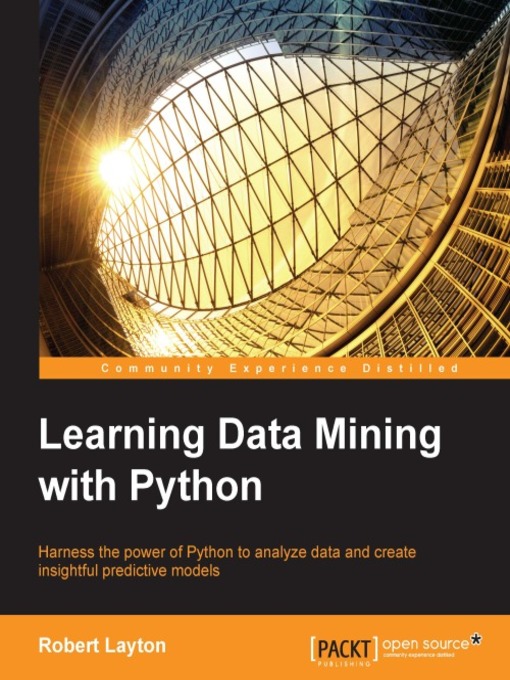
Learning data mining with Python
harness the power of Python to analyze data and create insightful predictive models
by Robert Layton
- 4 Want to read

Share
×Close









If you are a programmer who wants to get started with data mining, then this book is for you.
Check nearby libraries
Buy this book

Previews available in: English
Subjects
| Edition | Availability |
|---|---|
1

Learning data mining with Python: harness the power of Python to analyze data and create insightful predictive models
2015, Packt Publishing
in English
1784391204 9781784391201
|
aaaa
|
Book Details
Table of Contents
Cover
Copyright
Credits
About the Author
About the Reviewers
www.PacktPub.com
Table of Contents
Preface
Chapter 1: Getting Started with Data Mining
Introducing data mining
Using Python and the IPython notebook
Installing Python
Installing IPython
Installing scikit-learn
A simple affinity analysis example
What is affinity analysis?
Product recommendations
Loading the dataset with NumPy
Implementing a simple ranking of rules
Ranking to find the best rules
A simple classification example
What is classification?Loading and preparing the dataset
Implementing the OneR algorithm
Testing the algorithm
Summary
Chapter 2: Classifying with scikit-learn
scikit-learn estimators
Nearest neighbors
Distance metrics
Loading the dataset
Moving towards a standard workflow
Running the algorithm
Setting parameters
Preprocessing using pipelines
An example
Standard preprocessing
Putting it all together
Pipelines
Summary
Chapter 3: Predicting Sports Winners with Decision Trees
Loading the datasetCollecting the data
Using pandas to load the dataset
Cleaning up the dataset
Extracting new features
Decision trees
Parameters in decision trees
Using decision trees
Sports outcome prediction
Putting it all together
Random forests
How do ensembles work?
Parameters in Random forests
Applying Random forests
Engineering new features
Summary
Chapter 4: Recommending Movies Using Affinity Analysis
Affinity analysis
Algorithms for affinity analysis
Choosing parameters
The movie recommendation problemObtaining the dataset
Loading with pandas
Sparse data formats
The Apriori implementation
The Apriori algorithm
Implementation
Extracting association rules
Evaluation
Summary
Chapter 5: Extracting Features with Transformers
Feature extraction
Representing reality in models
Common feature patterns
Creating good features
Feature selection
Selecting the best individual features
Feature creation
Principal Component Analysis
Creating your own transformer
The transformer APIImplementation details
Unit testing
Putting it all together
Summary
Chapter 6: Social Media Insight Using Naive Bayes
Disambiguation
Downloading data from a social network
Loading and classifying the dataset
Creating a replicable dataset from Twitter
Text transformers
Bag-of-words
N-grams
Other features
Naive Bayes
Bayes' theorem
Naive Bayes algorithm
How it works
Application
Extracting word counts
Converting dictionaries to a matrix
Edition Notes
Includes index.
Classifications
External Links
The Physical Object
Edition Identifiers
Work Identifiers
Community Reviews (0)
Lists
Wikipedia citation
×CloseCopy and paste this code into your Wikipedia page. Need help?