




Oliver Twist
by Charles Dickens
- 837 Want to read
- 69 Currently reading
- 128 Have read







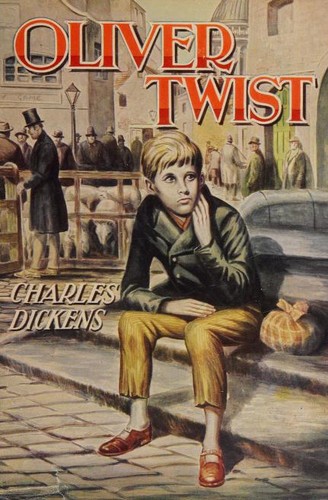


Charles Dickers, perhaps the greatest of all the great writes wrot many books. The story of the poor orphan boy, Oliver Twist, is one of the finest of all. The end of the first chapter tell the reader what to expect. It reads like this: "Oliver cried lustily. If he could have known that he was an orphan, left to the tender mercies of churchwardens and overseers, perhaps he would have cried louder".
You may have heard how Oliver Twist "asked for more" at the home where he was sent. If you have, now you can read the whole story of this poor boy, of Bill Sykes, of the Artful Dodger, of the Jew Fagin, of Nancy and of sweet Agnes and of other famous characters who come to life in a truly great book.
Poor Oliver Twist, what a lot he had to put up with, but what a wonderful story his life makes as it is told by a truly great writer.
Buy this book

Previews available in: English German Spanish Dutch French
Subjects
People
Places
Times
Showing 25 featured editions. View all 2209 editions?
| Edition | Availability |
|---|---|
01

|
bbbb
|
02

|
bbbb
|
03

|
bbbb
|
04

|
bbbb
|
05

|
bbbb
|
06

|
bbbb
|
07

|
bbbb
|
08

|
bbbb
|
09

|
bbbb
|
10

|
bbbb
|
11

|
bbbb
|
12

|
bbbb
|
13

|
bbbb
|
14

|
bbbb
|
15

Les Aventures d'Olivier Twist
1986-10-06, France loisirs
Hardcover
in French
- Edition du Club France Loisirs
2724231740 9782724231748
|
cccc
|
16

Oliver Twist (Progress English)
April 1985, Oxford University Press
Paperback
in English
- Abridged Ed edition
0195814851 9780195814859
|
cccc
|
17

|
eeee
|
18

|
cccc
|
19

Oliver Twist or, the Parish Boy's Progress INTERNATIONAL COLLECTORS LIBRARY SERIES #44529
1968, International Collectors Library
in English
|
cccc
|
20

Oliver Twist - Washington Square Press, Inc. Edition
1961-01-01, Washington Square Press, Inc.
in English
|
cccc
|
21

|
cccc
|
22

|
cccc
|
23

|
eeee
|
24

|
bbbb
|
25

|
aaaa
|
Book Details
Edition Notes
The Physical Object
Edition Identifiers
Work Identifiers
First Sentence
"AMONG other public buildings in a certain town, which for many reasons it will be prudent to refrain from mentioning, and to which I will assign no fictitious name, there is one anciently common to most towns, great or small: to wit, a work-house; and in this work-house was born-on a day and date which I need not trouble myself to repeat, inasmuch as it can be of no possible consequence to the reader, in this stage of the business at all events-the item of mortality whose name is prefixed to the head of this chapter."
Work Description
Oliver Twist; or, The Parish Boy's Progress, is the second novel by English author Charles Dickens. It was originally published as a serial from 1837 to 1839, and as a three-volume book in 1838. The story follows the titular orphan, who, after being raised in a workhouse, escapes to London, where he meets a gang of juvenile pickpockets led by the elderly criminal Fagin, discovers the secrets of his parentage, and reconnects with his remaining family.
Oliver Twist unromantically portrays the sordid lives of criminals, and exposes the cruel treatment of the many orphans in London in the mid-19th century.[2] The alternative title, The Parish Boy's Progress, alludes to Bunyan's The Pilgrim's Progress, as well as the 18th-century caricature series by painter William Hogarth, A Rake's Progress and A Harlot's Progress.
In an early example of the social novel, Dickens satirises child labour, domestic violence, the recruitment of children as criminals, and the presence of street children. The novel may have been inspired by the story of Robert Blincoe, an orphan whose account of working as a child labourer in a cotton mill was widely read in the 1830s. It is likely that Dickens's own experiences as a youth contributed as well, considering he spent two years of his life in the workhouse at the age of 12 and subsequently, missed out on some of his education.
Links outside Open Library
Lists
Wikipedia citation
×CloseCopy and paste this code into your Wikipedia page. Need help?