

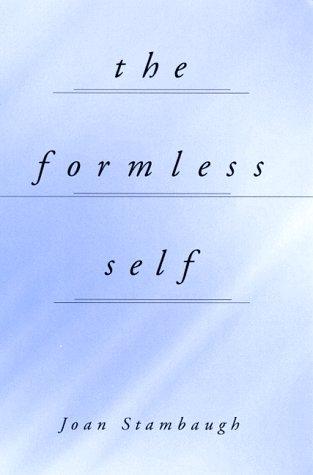
Gathering and interpreting material that is not readily available elsewhere, this book discusses the thought of the Japanese Buddhist philosophers Dogen, Hisamatsu, and Nishitani. Stambaugh develops ideas about the self culminating in the concept of the Formless Self as formulated by Hisamarsu in his book The Fullness of Nothingness and the essay "The Characteristics of Oriental Nothingness," and further explicated by Nishitani in his book Religion and Nothingness.
These works show that Oriental nothingness has nothing to do with the nineteenth- and twentieth-century Western concept of nihilism. Instead, it is a positive phenomenon, enabling things to be.
Previews available in: English
Subjects
People
| Edition | Availability |
|---|---|
1

|
aaaa
|
Book Details
Edition Notes
Includes bibliographical references and index.
Classifications
The Physical Object
Edition Identifiers
Work Identifiers
Source records
- Library of Congress MARC record
- amazon.com record
- marc_claremont_school_theology MARC record
- Library of Congress MARC record
- marc_claremont_school_theology MARC record
- Internet Archive item record
- Better World Books record
- Better World Books record
- marc_columbia MARC record
- marc_columbia MARC record
- Harvard University record
Community Reviews (0)
Lists

Wikipedia citation
Copy and paste this code into your Wikipedia page.
{{cite book|author=Joan Stambaugh |date=1999 |title=The formless self |url=https://archive.org/details/formlessself0000stam |publication-place=Albany |publisher=State University of New York Press |isbn=0-7914-4149-0 |lccn=98027672 |oclc=44960291 |ol=367167M}}