




The missile next door
the Minuteman and the arming of the American heartland
by Gretchen Heefner
- 1 Have read






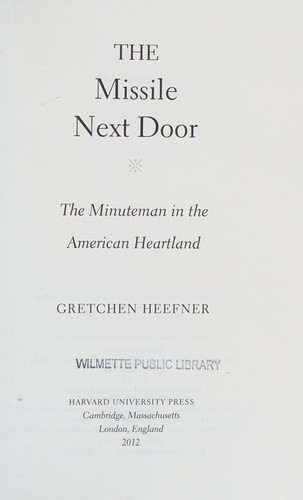


Between 1961 and 1967, the United States Air Force buried 1,000 Minuteman Intercontinental Ballistic Missiles in pastures across the Great Plains. This book tells the story of how rural Americans of all political stripes were drafted to fight the Cold War by living with nuclear missiles in their backyards -- and what that story tells us about enduring political divides and the persistence of defense spending. By scattering the missiles in out-of-the-way places, the Defense Department kept the chilling calculus of Cold War nuclear strategy out of view. The author argues that this subterfuge was necessary in order for Americans to accept a costly nuclear buildup and the resulting threat of Armageddon. As for the ranchers, farmers, and other civilians in the Plains states who were first seduced by the economics of war and then forced to live in the Soviet crosshairs, their sense of citizenship was forever changed. Some were stirred to dissent. Others consented but found their proud Plains individualism giving way to a growing dependence on the military-industrial complex. Even today, some communities express reluctance to let the Minutemen go, though the Air Force no longer wants them buried in the heartland.
Check nearby libraries
Buy this book

Previews available in: English
Subjects
Places
| Edition | Availability |
|---|---|
1

|
zzzz
|
|
2
Missile Next Door: The Minuteman in the American Heartland
2012, Harvard University Press
in English
0674070887 9780674070882
|
zzzz
|
3

The missile next door: the Minuteman and the arming of the American heartland
2012, Harvard University Press
in English
0674059115 9780674059115
|
aaaa
|
Book Details
Table of Contents
Edition Notes
Includes bibliographical references and index.
Classifications
The Physical Object
Edition Identifiers
Work Identifiers
Source records
Community Reviews (0)
Lists
Wikipedia citation
×CloseCopy and paste this code into your Wikipedia page. Need help?