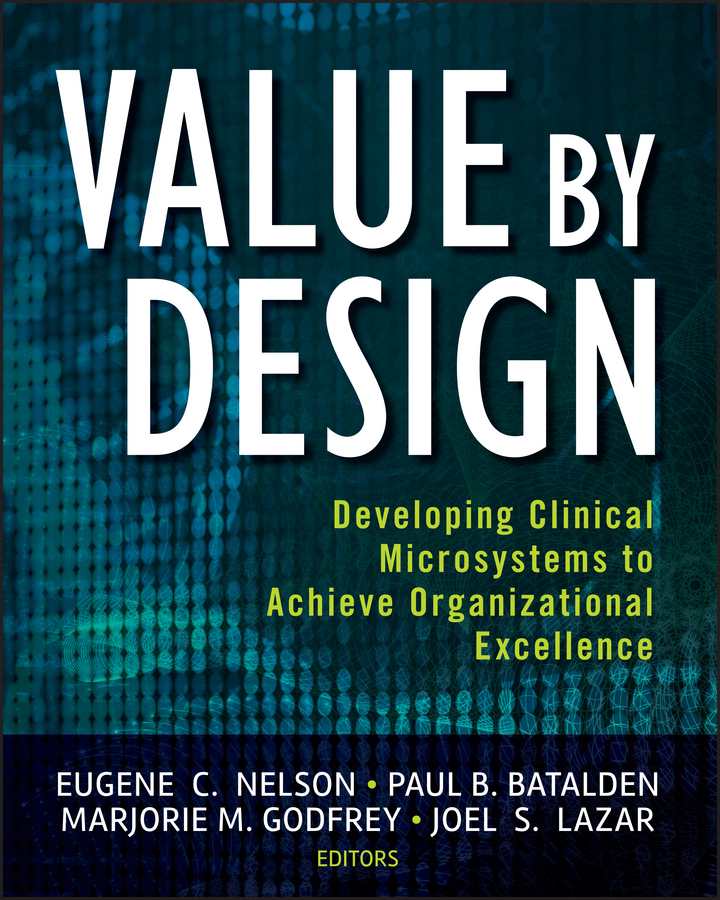
An edition of Value by design (2011)

Value by design

developing clinical microsystems to achieve organizational excellence

1st ed.
Locate

My Reading Lists:

Create a new list


Buy this book

Last edited by ImportBot
October 2, 2025 | History
An edition of Value by design (2011)

Value by design

developing clinical microsystems to achieve organizational excellence

1st ed.

"The clinical microsystems model is the approach for quality improvement in health care, endorsed by the American Hospital Association and the Joint Commission on Accreditation of Healthcare Organizations. Written by three leading experts in clinical quality improvement--authors of the bestselling Quality by Design--The Clinical Improvement Guide combines theory and principles for assessing and improving front-line clinical units with field-tested and refined practical tools to form a comprehensive approach to clinical improvement, assessment, and measurement of processes, outcomes, and performance for all the settings in which health services are delivered."--Provided by publisher.

Publish Date
Language
English
Pages
346

Buy this book

Edition Availability
Cover of: Value by Design
Value by Design: Developing Clinical Microsystems to Achieve Organizational Excellence
2013, Wiley & Sons, Incorporated, John
in English
Cover of: Value by Design
Value by Design: Developing Clinical Microsystems to Achieve Organizational Excellence
2011, Wiley & Sons, Incorporated, John
in English
Cover of: Value by Design
Value by Design: Developing Clinical Microsystems to Achieve Organizational Excellence
2011, Wiley & Sons, Incorporated, John
in English
Cover of: Value by Design
Value by Design: Developing Clinical Microsystems to Achieve Organizational Excellence
2011, Wiley & Sons, Incorporated, John
in English
Cover of: Value by design
Value by design: developing clinical microsystems to achieve organizational excellence
2011, Jossey-Bass, Wiley-Interscience
in English - 1st ed.

Add another edition?

Book Details


Table of Contents

The Entry Functions of Clinical Microsystems.
Conclusion.
Summary.
Key Terms.
Review Questions.
Discussion Questions.
References.
Set the following H1 in second color.
Chapter Five Action Guide.
Process Mapping with Flowcharts.
Access Measures and Tools.
C.A.R.E. Vital Signs.
Reference.
6: Designing Preventive Care to Improve Health.
Learning Objectives.
The Work of Preventive Health Care.
An Action-Based Taxonomy of Preventive Health Services.
Conclusion.
Summary.
Key Terms.
Review Questions.
Discussion Questions.
References.
Set the following H1 in second color.
Chapter Six Action Guide.
Radiology Microsystem Preventive Activity of Mammography.
7: Planning for Responsive and Reliable Acute Care.
Learning Objectives.
Anticipating the Needs of Acutely Ill Patients.
Defining Acute Care Needs of Patients and Families.
An Overview of Design Requirements for Acute Care.
Advanced Access and Effective Care Transitions
Conclusion.
Summary.
Key Terms.
Review Questions.
Discussion Questions.
References.
Set the following H1 in second color.
Chapter Seven Action Guide.
8: Engaging Complexity in Chronic Illness Care.
Learning Objectives.
An Invitation to Complexity.
The Experience of Chronic Illness.
The Burden of Chronic Illness.
The Goals of Chronic Illness Care.
Clinical Complexity in Chronic Illness Care.
Designing for Complexity Through Alignment of Problems and Practice Solutions.
The Nature of Complex Adaptive Systems.
The Chronic Care Model.
Care Coordinaton and Transitions.
Patient Self-Management.
Conclusion.
Summary.
Key Terms.
Review Questions.
Discussion Questions.
References.
Set the following H1 in second color.
Chapter Eight Action Guide.
Star Generative Relationships.
Reference.
9: Supporting Patients and Families Through Palliative Care.
Learning Objectives.
The Need for Palliative Care in Modern America.
End-of-Life Experience Yesterday and Today.
Principles of Palliative Care.
Reducing Variation in End-of-Life Care.
Core Processes in Palliative Care.
Care Coordination Near the End of Life.
Formal Palliative Care and Hospice Programs.
Planning for Both Life and Death with Advance Directives.
Conclusion.
Summary.
Key Terms.
Review Questions.
Discussion Questions.
References.
Set the following H1 in second color.
Chapter Nine Action Guide.
Mental Models.
Using the Ladder of Inference to Explore Mental Models.
Reference.
10: Designing Health Systems to Improve Value.
Learning Objectives.
From Parts to Whole.
New Vision of Integrated Systems to Produce High Value.
The Execution Triangle.
Leading Change at All Levels.
Changing Local Culture.
The Path Forward for Making High-Value Health Systems.
Summary.
Key Terms.
Review Questions.
Discussion Questions.
References.
Set the following H1 in second color.
Chapter Ten Action Guide.
Micro-, Meso-, and Macrosystem Matrix.
Name Index.
Subject Index.

Edition Notes

Includes bibliographical references and index.

Published in
San Francisco

Classifications

Dewey Decimal Class
362.1
Library of Congress
RA443 .V35 2011, RA399.A3

The Physical Object

Pagination
xxxiv, 346 p. :
Number of pages
346

Edition Identifiers

Open Library
OL24903402M
ISBN 10
0470385340
ISBN 13
9780470385340
LCCN
2010047562
OCLC/WorldCat
662400178

Work Identifiers

Work ID
OL15999223W

Community Reviews (0)

No community reviews have been submitted for this work.

Lists

Download catalog record: RDF / JSON / OPDS | Wikipedia citation