












It is not the intent of this discussion of the accuracy of Gaussian dispersion models to denigrate the importance and the usefulness of such models. In actual fact, those models are the best tools we have. But we must keep in mind that they are only tools and they do not provide the ultimate truth. The models can be very useful in qualitatively predicting which industrial plant designs and which plant sites should result in a lower impact on air quality. They can also be very useful in evaluating and selecting emission control methods. But they are far from being able to consistently predict actual dispersing plume concentrations by a factor within two or three. The consistent prediction of actual plume concentrations within a factor as high as ten is probably a more realistic assessment of the accuracy of Gaussian dispersion models used to calculate and predict short-term average concentrations. Once again, as stated at the beginning of this section, we must not confuse precision with accuracy.
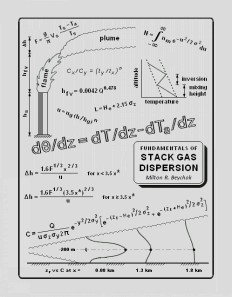
An edition of Fundamentals of Stack Gas Dispersion
(1979)
Fundamentals of stack gas dispersion
3rd ed.
by Milton R. Beychok
- 37 Want to read
- 2 Currently reading
- 1 Have read

Share
×Close
This edition is now out of print and no longer available. The 4th Edition is the current one.
Check nearby libraries
Buy this book

Previews available in: English
Subjects
Air, Air dispersion modeling, Air pollution, Atmospheric diffusion, Atmospheric dispersion modeling, Environmental aspects of Flue gases, Flue gases, Mathematical models, Pollution, Smoke plumes, air dispersion modelling, atmospheric dispersion modelling, Diffusion, Tables, Dispersion, Smoke| Edition | Availability |
|---|---|
1

Fundamentals of Stack Gas Dispersion
2005, Milton R. Beychok
eBook (PDF)
in English
- 4th edition
0964458802 9780964458802
|
zzzz
|
2

Fundamentals of stack gas dispersion
1994, Milton R. Beychok
in English
- 3rd ed.
0964458802 9780964458802
|
aaaa
|
3

|
zzzz
|
Book Details
Edition Notes
Classifications
Edition Identifiers
Work Identifiers
Source records
Work Description
This is the most comprehensive book on dispersion modeling of continuous, buoyant air pollution plumes which takes nothing for granted. Every equation is completely derived step-by-step without any complicated or advanced mathematics. Every constraint and assumption is fully explained. The Fourth Edition was published in 2005 and is the latest edition.
The subjects covered in the book include atmospheric turbulence and stability classes, buoyant plume rise, Gaussian dispersion calculations and modeling, time-averaged concentrations, wind velocity profiles, fumigations, trapped plumes, flare stack plumes and much more ... with a great many example calculations.
The book has been purchased in 84 countries and is currently available in 233 libraries worldwide. It has been referenced or cited as an educational resource 870 times in the technical literature and on the Internet, including the regulatory publications of 34 state or national governmental agencies worldwide. It has also been used as recommended reading or a textbook in 61 university courses.
More information is available at www.air-dispersion.com.
Updated Dec. 20, 2014.
Excerpts
Page 117,
added by Milton Beychok.
Because it is important to emphasize that the models for predicting the dispersion of air pollution plumes are merely tools and they do not provide results that are accurate to the nth degree. In fact, their predictions may be as much as 10 times higher or 10 times lower than the actual dispersion results.
Community Reviews (0)
Lists
| November 18, 2018 | Edited by MARC Bot | import existing book |
| December 20, 2014 | Edited by Milton Beychok | Minor update |
| November 27, 2014 | Edited by Milton Beychok | Updated |
| October 11, 2014 | Edited by Milton Beychok | Edited without comment. |
| December 9, 2009 | Created by WorkBot | add works page |